


Navigation
Contact us
Phone
Message
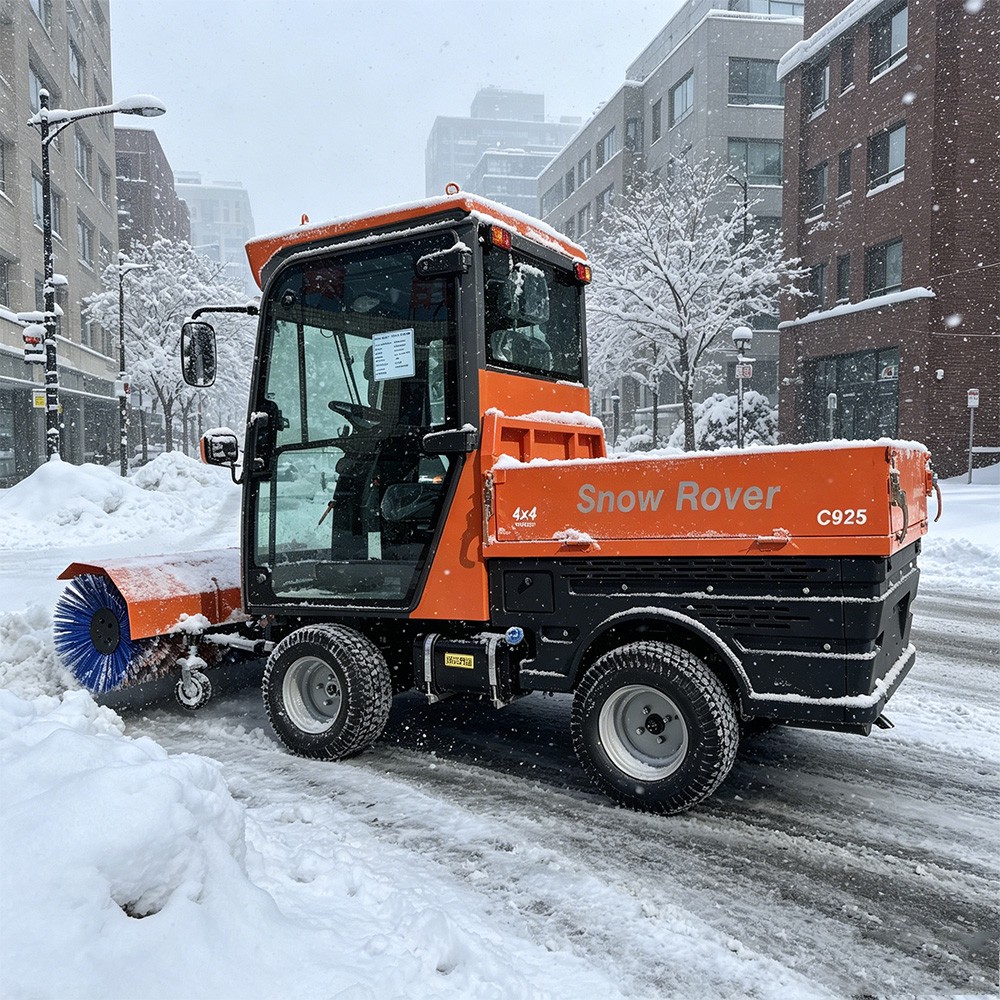
2026–2027 Winter Readiness Report: The Economics of Multi-Functional 4WD Snow Removal
[Facility & Winter Operations Journal] | Exclusive Feature: Seasonal Investment Audit 2026
Executive Summary
The 2026–2027 Winter Readiness Report examines the economics of multi-functional 4WD snow removal through the 4WD140 Enclosed Snow Sweeper. It quantifies the true cost of snow events — storm labor, overtime, contractor call-outs, repairs, and liability — and models how one machine with four quick-change functions (sweep, throw, shovel, spread) replaces a fleet of single-purpose units. Productivity benchmarks show a single 4WD140 clearing ~4,000 m² per hour — roughly eight times a walk-behind blower — with annual savings of $18,000–$27,000 and payback inside two winters against an 8–10 year service life. A 40-acre industrial park case study reports clearing time cut from eight hours to under two, 70% fewer overtime calls, and ~20% lower salt use. Available now for pre-season ordering.
Every winter, commercial facilities budget thousands of dollars for snow removal — then pay again in overtime, closed loading docks, and slip-and-fall liability. As snowfall events grow more frequent and labor harder to find, the question is no longer which machine to rent, but which investment pays back fastest.
This report examines the 4WD140 Multifunctional 4WD Enclosed Snow Sweeper as a model of capital-efficient snow operations — and quantifies the difference it makes on a typical commercial site.
I. The True Cost of a Snow Event
Most operators price snow removal by the hour. The real cost is broader: storm labor and overtime, contractor call-outs, salt and materials, machine repairs, and the quiet cost of facilities that stay closed while competitors stay open.
• Direct costs — storm labor, overtime premiums, rented equipment, salt
• Indirect costs — delayed shipments, closed docks, lost revenue per downtime hour
• Liability costs — slip-and-fall claims after incomplete clearing
• Maintenance costs — consumer-grade drivetrains failing under wet-snow load
II. Equipment Consolidation: From Three Machines to One
The 4WD140 replaces a fleet of single-purpose machines. Sweeping, throwing, shoveling, and salt spreading all run off one chassis with quick-change attachments — a 1400 mm brush, a 1200 × 600 mm thrower, a 1500 × 400 mm blade, and a 0.3 m³ salt / sand spreader.
The capital saving is immediate: fewer machines to buy, store, insure, and maintain. One compact unit — 2,500 × 1,300 × 1,980 mm and 659 kg — fits the garage bay that used to hold three.
III. Productivity Benchmark: What One Operator Can Clear
Work-rate is where the economics turn. With its 1400 mm brush at working speed, a single 4WD140 clears roughly 4,000 m² per hour — about eight times the output of a walk-behind blower and three times that of a typical 2WD ride-on unit.
IV. The Seasonal Payback Model
For a site that handles 12 or more storm events per season, the annual saving is material:
The 4WD140 Edge: Even at conservative labor rates, annual savings of $18,000–$27,000 put the payback inside two winters — and the machine keeps earning for an estimated 8–10 years of service.
V. The Most Expensive Failure: Being Down During a Storm
A machine that stalls in wet snow costs more than its repair bill. It costs the hour of clearing, the overtime that follows, and the client who watched a competitor stay open.
Consumer-grade 2WD units stall under load and break gearboxes under stress. The 4WD140’s industrial Runtong R740-1 engine (25 HP / 16.5 kW), CVT with cruise control, and multi-gear 4WD drivetrain are specified to keep working through the storm — not to fail in it.
VI. Case Study: A 40-Acre Industrial Park
At a 40-acre industrial park with 14 loading docks, a fleet of three 2WD machines and four manual workers was replaced by two 4WD140 units. Results over one season:
• Clearing time — full site cleared in under two hours, down from eight; docks reopened at first light
• Crew — four workers reduced to two operators; overtime calls cut by 70%
• Uptime — zero mechanical stops; previous fleet averaged 3–4 service events per season
• Material efficiency — controlled salt spreading cut de-icing material use by roughly 20%
• Payback — projected within two winters, including labor, repairs, and avoided downtime
Conclusion: Why Now
Snow seasons are arriving earlier and ending later. Equipment bought in fall pays for itself in the first major storm — and keeps paying every winter after. The 4WD140 is available now for pre-season ordering.
Contact us for the full specification sheet, pricing, or an on-site demo before the first snowfall.
This stunning beach house property is a true oasis, nestled in a serene coastal community with direct access to the beach.
Contact
West Street, Melbourne Victoria 3000 Australia